

If you’ve made it past the early stage, chances are, your business is going to make it.
You’ve likely raised millions in capital, proven that your offer has market demand, got a great customer base and received offers to purchase your business.
It’s time to focus on growing your startup. To do that, you secure Series B and C investments.

In April 2023, the startup received $105 million in Series C funding from six companies, led by Jeito Capital.
Venture capitalist firms are still at the forefront of your growth-fueling funding. Investment banks, private equity firms and hedge funds might start to take interest in your company, too.
One major part of the growth stage is scaling your team. You need the right people in the right place.
Scaling a company is a highly strategic endeavor. Scaling up too quickly could mean burning through your resources faster than revenue comes in. If you scale too slowly, you risk not being able to supply growing demand or fail to meet deadlines.
As a founder, you can’t wear all the hats anymore. You have to lean on the right people, including startup mentors, to reach the next stage.
The early stage is also known as “Series A.”
If you’ve got this far, hats off to you! According to VentureBeat, only 7.5% of seed-stage startups advance into an early-stage startup.
An early-stage startup, or Series A, is typically defined by having achieved a first round of venture capital financing.
Succeeding in this stage is only possible once your company has crafted a minimum viable product (MVP), established a sizable customer base and has a steady stream of monthly revenue.
In September 2022, Lyfegen raised $8 million in Series A funding from two investors, led by aMoon Fund.
One of the biggest challenges is proving your offer can generate revenue beyond the short term. You need to perfect your pitch deck and begin focusing heavily on venture capital (VC) firms. If you get one of them to invest, they’ll serve as an “anchor”, making it easier to attract additional investors.
Investors want to know what return on investment (ROI) they get with your startup. Incubators and accelerators such as BaseLaunch are helpful to get you investment-ready.
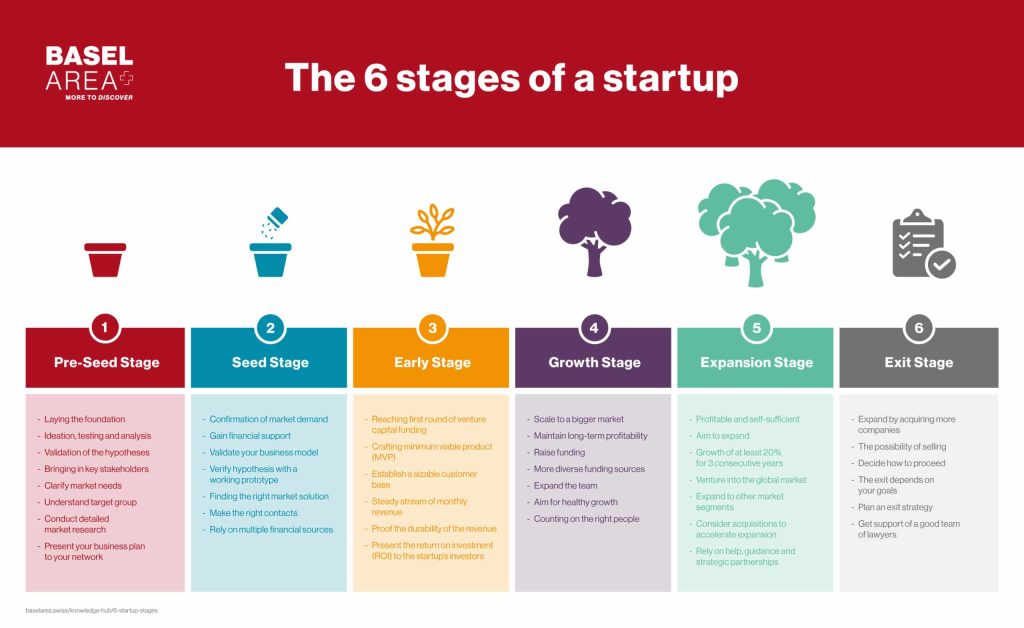
This stage is all about fueling the ideation process. It’s about testing and analysing your startup’s opportunities. Your goal is to determine if your product or service can be a viable solution to a real market problem.
In the pre-seed phase, founders should:
- Validate hypotheses for customers, demand and offering.
- Bring in key stakeholders (i.e. CTO, CFO, CMO, etc.) to convert funding on the idea.
- Register key patents and trademarks.

In March 2023, the startup received €4,000,000 in pre-seed funding from five investors.
Talking with and listening to your target audience is a crucial step to determine if there’s a real pain you’re alleviating. Conduct market research, surveys and interviews to understand your audience thoroughly.
Accurate, thorough market research isn’t cheap. You need to go beyond your personal investments to make it worthwhile. This means seeking out funding from initial investors. While you may be gung-ho to start hunting down VCs, it’ll be nearly impossible to convince them with the paper napkin business idea you have at this point.
Instead, your best bet is to pitch your business plan to your personal network. Just remember, you should still get everything down in writing. This goes for any contracts, funding and partnership agreements, copyrights and any other legal documents. If you wait until later stages to get official documents signed up, you could be dealing with headaches, paperwork and potentially lawsuits down the road. Read more about IP protection for startups.
In the seed stage, you completed initial product and market research and it has shown viable demand for your solution. You’ve got more than an idea. You’ve got the data to back up that your offer can be a real solution in the marketplace.
Now, it’s time to gain early financial support to turn your idea into a functioning business. This is where seed funding comes in. In this stage, you validate your entire business model.
You conduct experiments and carry out market testing to make your product and operations more tangible. Just keep in mind, the goal here is to validate your initial value hypothesis with a working prototype.
While the pre-seed phase is known as the “idea phase,” the seed phase is known as the “prototype phase” as you do need to have a prototype to test. This doesn’t mean you have to have a minimum viable product (MVP) yet—that will come in the early stage.

seniors@work had a successful appearance in the TV show “Lion’s Den Switzerland” and gained CHF 60,000 in seed money.
To master the seed stage, you need to make multiple iterations of your product to create the right market solution.
Think of it as chiseling a basic stone statue down to form a masterpiece. This means even more experimenting, market testing and adjustments to your marketing strategy.
In terms of financing, you need to begin connecting with the right people. To succeed in the seed stage, you best rely on multiple startup funding sources. These include your revenue, angel investors, crowdfunding and accelerators. Since your business is still in its initial stages, it’s a major risk for investors. This usually means you have to hand over an equity stake in your business in return.
To master the seed stage, you need to make multiple iterations of your product to create the right market solution.
Think of it as chiseling a basic stone statue down to form a masterpiece. This means even more experimenting, market testing and adjustments to your marketing strategy.
In terms of financing, you need to begin connecting with the right people. To succeed in the seed stage, you best rely on multiple startup funding sources. These include your revenue, angel investors, crowdfunding and accelerators. Since your business is still in its initial stages, it’s a major risk for investors. This usually means you have to hand over an equity stake in your business in return.
In September 2022, Lyfegen raised $8 million in Series A funding from two investors, led by aMoon Fund.
One of the biggest challenges is proving your offer can generate revenue beyond the short term. You need to perfect your pitch deck and begin focusing heavily on venture capital (VC) firms. If you get one of them to invest, they’ll serve as an “anchor”, making it easier to attract additional investors.
Investors want to know what return on investment (ROI) they get with your startup. Incubators and accelerators such as BaseLaunch are helpful to get you investment-ready.
If you’ve made it past the early stage, chances are, your business is going to make it.
You’ve likely raised millions in capital, proven that your offer has market demand, got a great customer base and received offers to purchase your business.
It’s time to focus on growing your startup. To do that, you secure Series B and C investments.
In April 2023, the startup received $105 million in Series C funding from six companies, led by Jeito Capital.
Venture capitalist firms are still at the forefront of your growth-fueling funding. Investment banks, private equity firms and hedge funds might start to take interest in your company, too.
One major part of the growth stage is scaling your team. You need the right people in the right place.
Scaling a company is a highly strategic endeavor. Scaling up too quickly could mean burning through your resources faster than revenue comes in. If you scale too slowly, you risk not being able to supply growing demand or fail to meet deadlines.
As a founder, you can’t wear all the hats anymore. You have to lean on the right people, including startup mentors, to reach the next stage.
The next stage (and final stage for many founders), is the expansion stage. You’re already profitable and self-sufficient. Many people will no longer consider your business a startup. With the greater market in mind, your goal is to expand further.
A key indicator that you’re in the expansion stage is if you’ve managed to grow more than 20% annually for three consecutive years (in billing or employee count). At this point, your startup becomes a “scaleup,” according to the Scaleup Institute.

In February 2023, Acrotec acquired its first U.S. company Axial Medical, a precision medtech manufacturer based in Warminster, Pennsylvania.
You can also start considering acquisitions to accelerate expansion and take up a greater market share.
To tap into expansion, startup founders and executives typically seek outside counsel such as startup mentors and other founders who have gone through the expansion phase themselves. The further you go through each stage, the more you must rely on help, guidance and strategic partnerships to fuel business growth.
We’ve heard of the final startup stage many times before: “The Exit.”
This stage is optional and is oftentimes presented to founders naturally.
The foundation for a proper exit starts early: The values and assets you build will define the price of your venture. The relationships you foster will contribute to the trust that potential buyers have in you. Mastering “The Exit” depends on your goals. If the opportunity for an exit arises, the first critical decision is to determine whether you continue expanding your current business venture. It’s essential to assess the state of your startup and your own aspirations carefully.
There are three main ways to exit:
- Sell founder’s shares to another company
- Get acquired by another company
- Initial Public Offering (IPO)

In 2020, the Germany-based pharma company Boehringer Ingelheim acquired NBE-Therapeutics for $1.4 billion. Today, NBE-Therapeutics is a wholly owned subsidiary of Boehringer Ingelheim.
Define Your Exit Strategy: Start by outlining your goals and the outcomes you wish to achieve with your exit. Determine whether you want to sell founder’s shares, get acquired, or go public through an IPO. The choice should align with your long-term vision and the values your startup represents.
Build Valuable Relationships: Recognise that the groundwork for a successful exit is often laid well in advance. Cultivate valuable relationships in your industry and establish trust with potential buyers or investors. These connections can significantly impact the outcome of your exit.
Timing Is Key: Acknowledge that the timing of your exit is crucial. Market conditions and investor sentiment can significantly affect the success of your exit. Be aware that the current landscape may be more challenging for startups to secure favourable deals than it was in previous years.
Legal Support: Engage a team of experienced lawyers who specialise in mergers and acquisitions, IPOs or other relevant areas. Legal professionals can ensure that your exit proceeds smoothly, all regulatory requirements are met, and your interests are protected throughout the process.
Credit: Basel Area Business & Innovation
Creating a vibrant ecosystem supported by experts and visionaries with enthusiasm for growing.